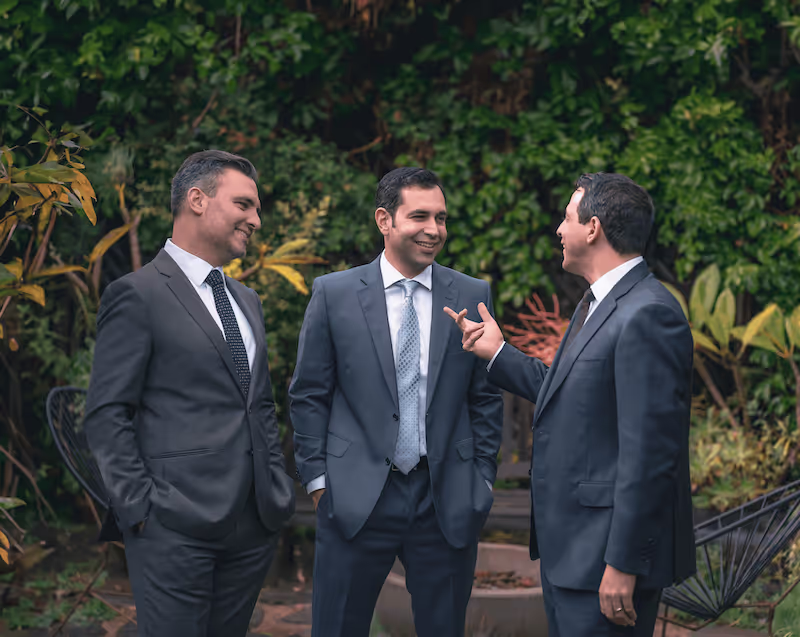


Why us
Why people choose Kermani LLP
Personal Attention & Results: We’re highly-rated by our clients and have recovered over $300,000,000 in combined verdicts and settlements.
Recovered for Clients
Litigated Trials
Successful Cases
Attorneys & Staff
VERDICTS & SETTLEMENTS
We deliver results for our clients
We believe that everyone deserves to be treated fairly, and we're here to fight for our clients' rights.

How it works
About our process
Our approach is thorough and empathetic. We strive to fully understand your situation and all potential damages.
STEP 1
STEP 2
STEP 3
STEP 4
table of contents
Every day, thousands of workers across Atlanta climb scaffolding, operate cranes, and run cable alongside live power lines. The city's construction boom (high-rise projects in Midtown, data centers throughout the region, and commercial redevelopment in Buckhead) means more job sites, more workers, and more risk. When something goes wrong on a construction site, the consequences tend to be severe: spinal fractures, traumatic brain injuries, electrical burns, and amputations.
If you've been hurt, someone probably told you to file for workers' comp. That's the right first step. But here's what they likely didn't explain: workers' compensation covers your medical bills and roughly two-thirds of your lost wages. That's it. No compensation for pain. No recovery for lost career potential. No penalties for the people who cut corners on safety.
On nearly every construction site, someone other than your direct employer shares responsibility for your injury. The general contractor, a subcontractor, the manufacturer of defective equipment, or the property owner could all be defendants in a separate civil lawsuit. That lawsuit, known as a third-party claim, is what opens the door to full compensation: pain and suffering, 100% of lost earnings, and future medical costs.
At Kermani LLP, we focus on identifying those defendants and proving their liability. That's why clients choose us as their Atlanta construction accident lawyer, someone who pushes recovery far beyond standard workers' comp payouts. Our $51.3 million verdict in Maggio v. First Solar Corporation is proof of exactly that approach.
Workers' Comp vs. a Personal Injury Lawsuit: What's the Difference
Georgia workers generally cannot sue their direct employer for an on-the-job injury. This principle is called the Exclusive Remedy Rule, codified in O.C.G.A. § 34-9-11. It limits an injured worker's rights to the workers' compensation system: medical bill coverage and partial wage replacement.
In practice, that means you receive payment for medical expenses and about 66% of your average wages while you're unable to work. It sounds reasonable until you compare it to what you've actually lost. That's why a skilled Atlanta construction accident attorney immediately investigates whether a third party caused or contributed to the accident.
A worker with a severe spinal cord injury may spend months in rehabilitation. First-year treatment costs for a serious spinal injury often exceed $500,000. Workers' comp will cover the medical bills, but lost career opportunities, chronic pain, and diminished quality of life? None of that gets compensated.
A third-party lawsuit works differently. Through a civil claim, you can pursue:
- Full lost wages, not two-thirds but 100%
- Pain and suffering
- Loss of future earning capacity
- Diminished quality of life
- In certain cases, punitive damages
Both processes can run simultaneously. Workers' comp begins paying almost immediately while we prepare and pursue the civil case against responsible third parties. A qualified construction accident injury lawyer coordinates both tracks to maximize your total recovery.
Who Can You Sue? Identifying Third-Party Liability
Construction sites rarely involve just one company. A typical Atlanta project includes a general contractor, dozens of subcontractors, equipment suppliers, architects, and inspectors. Any of them may bear responsibility for your injury, and O.C.G.A. § 34-9-11 expressly preserves a worker's right to sue a third-party tortfeasor. The job of a construction accident attorney in Atlanta is to determine exactly who violated their duty and how much liability each defendant carries.
General Contractors
The general contractor runs the site. If they failed to enforce safety protocols, skipped inspections of hazardous areas, or ignored OSHA violations, they can be held liable. In Maggio v. First Solar, we proved that both the general contractor and the solar panel manufacturer controlled key aspects of the site and its electrical systems and that their failures led directly to our client's electrocution.
Subcontractors
An electrician from one company leaves exposed wiring. A concrete crew from another fails to secure formwork. A crane operator from a third violates lifting protocol. On a construction site, one crew's mistake injures workers from another. Not all construction accident law firms take on the challenge of unraveling that chain of responsibility, but that's exactly how you identify the liable subcontractors and determine who pays for your injury.
Equipment Manufacturers
Defective scaffolding, a malfunctioning crane, and a substandard safety harness. When equipment fails due to a design or manufacturing defect, you may have a product liability claim. Strict liability applies in cases involving defective construction equipment: you only need to show the product was defective and that the defect caused your injury, without proving intent or negligence on the manufacturer's part.
Property Owners
Building and land owners have a duty to warn contractors about known hazards: unstable soil, buried utilities, and toxic materials. This comes up frequently during renovation work on older Atlanta buildings, where hidden asbestos insulation and outdated electrical wiring remain common problems. Suburban growth brings its own version of this issue, and a construction accident lawyer in Alpharetta regularly sees owners who failed to disclose known soil instability or buried utility lines on newly developed parcels. If the owner knew and stayed silent, they bear liability.
Common Construction Accidents We Litigate
According to the Bureau of Labor Statistics, 1,034 construction workers died on the job in the U.S. in 2024 (BLS CFOI final data, published February 2026), more than in any other industry. Georgia recorded 170 total workplace fatalities that same year. Construction accident lawyers most commonly encounter four categories of incidents that OSHA calls the Fatal Four, which together account for more than 60% of all construction deaths.
Scaffolding and Ladder Falls
Falls cause over 36% of all construction fatalities. Collapsed scaffold railings, untested fall-arrest systems, and wet surfaces at height are all scenarios that violate OSHA 1926 standards (Subpart M, Fall Protection). In 2024, 389 construction workers nationwide died from falls (BLS final data, published February 2026). Even a drop from just 6 feet can result in a traumatic brain injury or spinal fracture with permanent consequences. A separate category involves injuries at roadway construction zones, where the hazards of elevated work combine with high-speed traffic. An Atlanta roadway construction accident lawyer helps those victims hold both the contractor and drivers who violated work-zone rules accountable, cases that often overlap with car accident claims.
Crane and Heavy Machinery Accidents
A failed hydraulic system. An overloaded boom. No signal person during a lift. With the volume of high-rise projects in Midtown and data centers across metro Atlanta, crane and heavy equipment accidents are far too common here. Construction accident attorneys see catastrophic injuries in these cases: crush injuries, amputations, and multiple fractures.
Electrocution and Burn Injuries
Electrocutions account for roughly 8.5% of construction fatalities, but their consequences rank among the most devastating. Industrial-voltage current inflicts electrical burn injuries, damaging not only the skin but also to internal tissue, the heart, and the nervous system. In the Maggio case, our client was exposed to utility-scale electrical current at a solar power plant construction site. He survived, but with severe and lasting consequences: electrical burns, a traumatic brain injury, and cardiac complications requiring lifelong monitoring.
Struck-By Incidents
A brick from an upper floor. An unsecured tool. A collapsed structural element. Struck-by incidents are the second-leading cause of construction worker deaths after falls. Hard hats reduce the risk but don't eliminate it: a heavy object falling from several stories up inflicts injuries that often make returning to work impossible.
How OSHA Regulations Strengthen Your Case
An OSHA violation is more than a fine for the contractor. It can become the most powerful piece of evidence in your civil lawsuit.
Georgia courts treat violations of federal safety standards as strong evidence of negligence. In some cases, the doctrine of negligence per se applies: if the defendant violated a specific safety standard and that violation caused the injury, negligence is established as a matter of law. No further proof is required.
Here's what that looks like in practice: if a site lacked guardrails at height (violating OSHA 1926.502) and a worker fell, we don't need to separately prove the defendant “acted unreasonably.” We show the violation and the causal connection to the injury.
We pull OSHA reports for every site where an accident occurred, review the history of inspections and citations, and bring in construction safety experts. A skilled construction accident lawyer in Atlanta uses this data to build an evidence foundation that weakens the defense's position well before trial begins.
Our $51.3 Million Verdict: Why Experience Matters
In Maggio v. First Solar Corporation, construction worker Kelley Maggio suffered an industrial-voltage electrocution at a solar power plant. The investigation revealed that the accident resulted from First Solar Corporation's failure to follow electrical safety procedures.
The case took six years. The defense denied the severity of the injuries and refused to settle. Their medical experts questioned whether Maggio's chronic health problems were even connected to the electrocution. Only on the eve of trial did they offer $6 million, twelve times less than what the jury ultimately awarded.
The turning point came during cross-examination of the defense's electrical injury expert. Our team exposed major gaps in the research he relied on and demonstrated that our client's ongoing pain and complications were a direct result of the electric shock. Drone technology allowed us to reconstruct the accident scene, showing the jury exactly how the electrocution happened and proving that neither the worker nor his direct employer was at fault.
$51.3 million was the product of methodical, six-year litigation. Kermani LLP is a construction accidents law firm that knows how to build cases against major construction corporations, because we've done it before and won.
Damages Recoverable in Construction Accident Cases
An experienced Atlanta construction accident lawyer evaluates the full scope of harm, accounting for every category of compensation available under Georgia law.
Economic damages: all medical expenses (past, present, and future), full lost wages during the period of disability, loss of future earning capacity (for construction workers whose livelihood depends on physical labor, this is often the largest component), plus rehabilitation costs and adaptive equipment.
Non-economic damages: pain and suffering, emotional distress, diminished quality of life, and loss of consortium, which is compensation for a spouse who has lost the full benefit of the marital relationship due to the injury.
Punitive damages: when a contractor knowingly ignored safety requirements or sent workers into a known hazard without proper protective equipment, the court may award punitive damages under O.C.G.A. § 51-12-5.1. If the accident was caused by someone under the influence of drugs or alcohol, the statutory cap on punitive damages does not apply.
In fatal construction accidents, the victim's family has the right to file a wrongful death lawsuit within two years of the date of death (O.C.G.A. § 9-3-33).
Contact Kermani LLP
A construction injury changes your life in seconds. How you fight for compensation determines what that new life looks like.
Workers' comp offers the bare minimum. We find the parties who owe you the rest. Whether you need an Atlanta construction accident lawyer downtown or a construction accident attorney in Alpharetta, call Kermani LLP for a free case evaluation. We'll determine whether third parties are responsible for your injury and lay out your next steps right now.

Discover your legal options. Get a free case review, and pay nothing unless we win.
Testimonials
What Our Clients Say About Us
We are committed to providing our clients with the best possible service, and their feedback is what drives us to be better.
Frequently Asked Questions
Our personal injury team is here to help. Get a free case evaluation.
Can I collect workers' comp and still file a lawsuit against a third party
Yes. Workers' compensation and a civil lawsuit are two separate legal mechanisms, and they run in parallel. Workers' comp starts paying almost right away, covering medical bills and partially replacing lost wages. While those benefits flow, we prepare and pursue a separate claim against the negligent third parties. One thing to keep in mind: if you recover damages through the civil case, the workers' comp insurer has a subrogation right to recoup some of what it paid out (O.C.G.A. § 34-9-11.1). We factor this into case strategy from day one.
What if I was partially at fault for the accident
Georgia follows a modified comparative negligence rule with a 50% threshold (O.C.G.A. § 51-11-7). If your share of fault is below 50%, you can still recover damages, but they're reduced in proportion to your responsibility. At 20% fault on a $1 million case, you'd receive $800,000. But if a court finds you 50% or more at fault, you lose the right to any compensation. Defense insurers routinely try to shift as much blame as possible onto the injured worker. Our attorneys build the evidence to stop that from happening.
Who pays my medical bills if my workers' comp claim gets denied
A denied workers' comp claim is not a dead end. We help challenge the denial through the administrative process at the Georgia State Board of Workers' Compensation. At the same time, we investigate whether a third party bears responsibility for the accident. If so, medical expenses become part of the civil lawsuit. During the dispute, your costs may be covered by personal health insurance, with the balance resolved after the case concludes.
What is the statute of limitations for a construction accident claim
Personal injury claims in Georgia carry a two-year deadline from the date of the accident (O.C.G.A. § 9-3-33). Miss it, and you lose the right to sue entirely. Wrongful death claims also have a two-year window, but the clock starts from the date of death. For minors, the filing period is tolled until age 18 (O.C.G.A. § 9-3-90). Early action matters: surveillance footage gets overwritten, witnesses forget details, and OSHA inspection records can become harder to obtain.
Can I file a lawsuit if I'm an undocumented worker
Immigration status does not bar you from seeking compensation for a workplace injury in Georgia. Workers' compensation applies to all employees regardless of documentation. Your right to file a civil lawsuit against third parties remains fully intact. Kermani LLP is a multilingual team. We maintain strict confidentiality and do not share information with immigration authorities.
Do you handle construction accident cases in Alpharetta and the Atlanta suburbs
The construction boom extends well beyond downtown. Major projects along GA-400, around Avalon, and across North Fulton have made Alpharetta one of the most active building zones in the region. If you're looking for an Alpharetta construction accident lawyer, Kermani LLP handles cases across all of metro Atlanta, including Marietta, Roswell, and Sandy Springs. We know the contractors working on local sites and the nuances of municipal regulations. Call us for a free consultation. We're available around the clock.
How much does it cost to hire Kermani LLP
We work on a contingency fee basis: you pay nothing unless we win your case. The initial consultation is free. We'll review the circumstances of your accident, identify potential defendants, and explain your compensation options, with no obligation on your part.
Practice areas
Explore More
Explore other practice areas our firm specializes in
Receive a FREE case assessment
Every case is unique, so we tailor our approach to meet your specific needs.